
Beyond the numbers: Leading with strategic vision
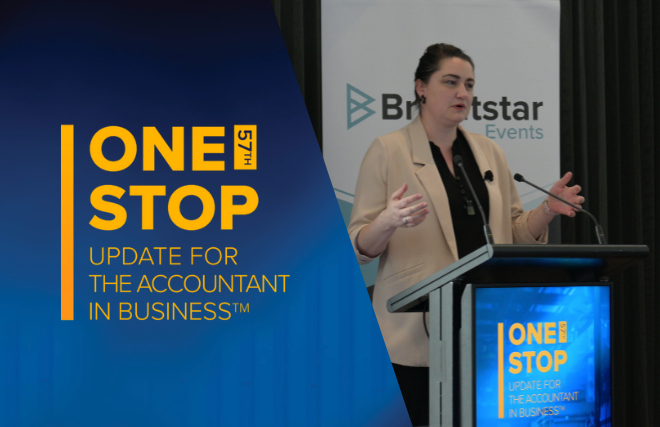
Our recent Auckland One Stop Update for the Accountant saw Colgate-Palmolive NZ Country Finance Manager Annelize du Toit share her observations on how finance leadership has evolved and some thought-provoking advice for emerging leaders to remain strategic.
The finance function has undergone a significant and undeniable evolution, taking on a decidedly strategic role within businesses of all sizes, from small enterprises to global corporations. The question is no longer if our role is strategic, but rather, “If it’s not about the numbers anymore, then what is it about?” The simple answer is: value, insight, collaboration, and partnership.
The Finance Evolution: A Gecko’s Lesson
Annelize memorably considers the fascinating case of the New Zealand gecko. Unlike most geckos globally that lay eggs outside of their body, native New Zealand species have eggs that are retained within the mother’s body, which then hatch inside the mother right before she gives birth. This biological change (called Ovoviviparity) is an adaptation to survive in colder climates.
Similarly, the finance function has fundamentally evolved to adapt to a changing business world. When many started their careers, adding value beyond the numbers wasn’t necessarily a given; our primary mandate was stewardship of business assets and delivering accurate financials.
Today, the shift is to strategic partners, demanding that we consider qualitative and non-quantitative insights to deliver the right information in real-time, at the right time.

🧭 Defining Strategic Leadership
To be a true strategic leader is to aim for a clear vision with long-term planning. It means:
Making future-focused decisions.
Motivating others to achieve shared goals.
Foreseeing future needs while also translating the vision into tangible actions today.
As finance professionals, we are now expected to create a roadmap, align the resources we once merely stewarded, and inspire action to turn vision into reality.
Practical Tips for Strategic Development
How can both the next generation and seasoned professionals ensure they remain strategic? Here Annelize shares her top tips and advice for anyone aspiring to lead in the finance function and beyond.
1. Cultivate Unrelenting Curiosity
Curiosity is what will keep setting us apart. While information is power, the depth of knowledge truly matters. She encourages rotation into field, operations, sales, or customer-facing portions of the business. This is where the missing depth is found, far away from complex data on a screen.
Example: To truly optimize warehouse space, send an accountant – someone with fresh eyes – to observe the supply chain team.
2. Embrace Two-Way Mentoring
Mentoring is a shared relationship where the benefits are often in equal portions, though sometimes the mentor may even benefit more. There is ample opportunity to draw on the mentee relationship to understand current trends, the evolving customer base, and the workforce we are trying to recruit and retain.
3. Conduct a Personal SWOT Analysis
To lead strategically, you must understand your own position. A personal SWOT analysis (Strengths, Weaknesses, Opportunities, and Threats/Challenges) is worth undertaking. You must continuously self-reflect and assess:
Your technical sphere and innate capabilities.
The environments you’ve been exposed to.
Your current situation and its reality.
Be courageous enough to acknowledge that self-development doesn’t stop when you’ve hit a milestone. Boldly share your learnings, too.

🤝 Empowerment and Authority to Engage
To elevate your impact, you must effectively engage and influence others. Research shows three common effective methods of influence:
Rational Persuasion: Using logic and facts—an innate strength for finance professionals.
Relationship-Based Approaches: Building rapport and trust.
Appealing to Needs and Values: Connecting with what matters to the other person.
Annelize also advocates always showing up with a point of service: asking, “How can I serve you today?” This principle bridges cultural and positional differences, helping others see you as a partner, not just a constant taker.
🗣️ Developing Essential Soft Skills
The intangible skills are becoming increasingly critical for future success:
Emotional Intelligence, Communication, and Body Language: The younger generation risks losing the art of body language and in-person negotiation if we don’t stress the importance of these skills. There will always be a place for in-person discussions and communications.
“Who’s Asking?”: Perspective-taking is crucial. By understanding the audience of any request, you change the way you approach tasks, deciding how deep or high-level to take the delivery. This makes people feel heard and seen.
Active Listening: In an age of instant gratification and short-form media, active listening is a skill that must be constantly practiced and honed.
Seeking Feedback with Intent: Don’t just ask for feedback; seek it with the genuine intention of doing something with it. Trusted feedback is a source of true reflection to know your blindspots.
🌟 A Call to Strategic Action
Just like the New Zealand gecko, the finance team and leader must continue to evolve. Even if the numbers remain the core job, Annelize encourages us to look beyond them and become a strategic partner in any business.
Continue the conversation
Keen to connect with other thought leaders in finance? Don’t miss our next One Stop conference happening in May 2026, or check out our other Finance & Accounting February events:
📌 IFRS Masterclass
📌 Sustainability and Climate Reporting
📌 Management Accounting Conference