
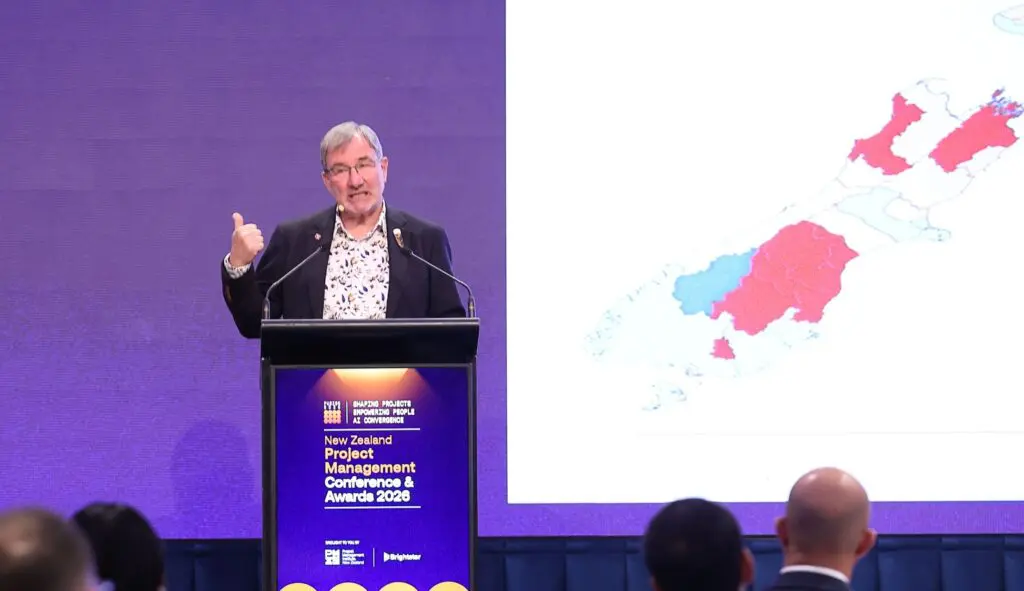
For decades, New Zealand’s business strategies relied on familiar assumptions: steady growth of families and many more births than deaths, traditional skills pipelines including immigrants, mostly from the UK and Ireland, and retirement fixed at age 65.
In an in-depth address at both our Project Management Conference and Primary Industries Summit, Massey University Distinguished Professor Emeritus Paul Spoonley explores Aotearoa’s structural transformation, where treating diversity and demographic shifts as optional is no longer viable.
“While we’re getting some short-term political push back, I think demography is destiny. I think we’re going to need to recognise what diversity means for us.” – Professor Paul Spoonley
1. The Ageing Imperative: Beyond the 65-Year-Old Myth
New Zealand’s population is ageing rapidly, tracking alongside nations like Japan with high older-worker participation.
- Structural shifts and life expectancy: Average life expectancy is projected to reach 91 by mid-century, with female life expectancy in certain ethnic groups pointing toward 94, meaning nearly half will live to be 100.
- Regional and rural ageing: Many rural and provincial districts face accelerated ageing as younger cohorts migrate toward major urban hubs, leaving behind older populations on fixed incomes with intensifying infrastructure and healthcare pressures.
- The older workforce: With age 65 no longer marking retirement for many, mature workers represent an underutilised resource requiring flexible workplace policies.
2. Declining Fertility, Youth Scarcity, and the Dependency Ratio
Sub-replacement fertility is reshaping high-income nations, and New Zealand is no exception.
- The fertility drop: Following a peak around 2010 to 2012, New Zealand’s total fertility rate has dropped to approximately 1.5, well below the 2.1 replacement threshold.
- Impact on education: Contracting primary school rolls, especially in some regions and rural areas, will steadily flow through to secondary and tertiary sectors.
- Dependency ratios: Treasury projections indicate the old-age dependency ratio will shift from 7 workers per superannuant (1960) down to a projected 2 to 1 ratio (2065), currently at 4 to 1 (2025).
3. Superdiversity, Net Migration Waves, and the Auckland Melting Pot
Immigration and cultural shifts have made Auckland exceptionally superdiverse.
- Global standing and scale: Auckland ranks as the fourth most diverse city globally, with 43% of residents born overseas and nearly half of annual national population growth occurring in the city. National growth is driven largely by non-citizen inflows offsetting departing citizen losses.
- Shifting source countries: Moving beyond traditional UK and Ireland migration, net inflows are dominated by India, China, the Philippines, Sri Lanka, Samoa, and South Africa. Sectors like construction and healthcare rely heavily on this talent, with around 40% of recent doctors and nurses trained overseas.
- Non-economic drivers: As Professor Spoonley notes, migrants choose Aotearoa for non-economic values:
“When we ask them why they come here as immigrants… they don’t come here to make money. They can go to other places for that, but they like our values, they like our lifestyle, they like our education system, and they like that we’re a safe country.” – Professor Paul Spoonley
- Cultural shifts: Māori and Pacific populations have a much younger age profile and higher fertility. By the 2030s, self-identified Māori children will comprise roughly a third of primary school students.
4. The Business Case for Inclusion: Actionable Strategies and Bottom-Line Results
For organisations facing talent shortages, diversity is a commercial necessity. Two-thirds of immigrants arrive via the Skilled Migrant Category, meaning that they are better skilled and tertiary qualified than the average member of New Zealand’s resident population – how can our economy fully utilise this talent pool?
- The financial upside: McKinsey research highlighted by Professor Spoonley shows firms embracing gender and ethnic diversity achieve up to a 39% uplift in economic returns.
- Moving beyond tokenism: Professor Spoonley warns against corporate complacency:
“I get really frustrated when a firm says ‘yeah, we got policies for gender or ethnic diversity’ and I say ‘well, how are you doing?’ and they say ‘well, we don’t collect data because we don’t want to ask our employees their ethnic identity.’ Well, I’m sorry, you do have to.” – Professor Paul Spoonley
- Bridging the integration gap: While two-thirds of our migrants arrive skilled, New Zealand lacks state-backed integration and settlement support. Pointing to Canadian models offering 400 hours of free language instruction, employers must step up with language support, safety training, and building networks.
- Adapting to new clients: Large immigrant-owned businesses and communities bring new customer expectations, requiring traditional service providers to adapt.
Conclusion: Demography is Destiny
For people leaders and business owners across Aotearoa, these shifts demand a rethink in how we plan, recruit, and operate. By embedding demographic realities into our core strategic thinking and corporate policies, we can future-proof our organisations for the decades ahead.
📌 Is Your Business Ready for 2027 and Beyond?
Power your teams and business with the deep insights needed for 2027 and beyond. Connect with industry leaders and thought leaders like Professor Spoonley at our key sector conferences to stay up to date and future-proof your organisation. Explore our events:

The Strategic Finance Series
Employment Leave Reform Conference

Emergency Management & Catastrophic Event Planning Conference

Fleet, Tech & e-Mobility Conference & Expo

National Cyber Security Summit

The Workplace & Executive Support Show
New Zealand Project Management Conference & Awards
Annual Industrial & Employment Relations Summit