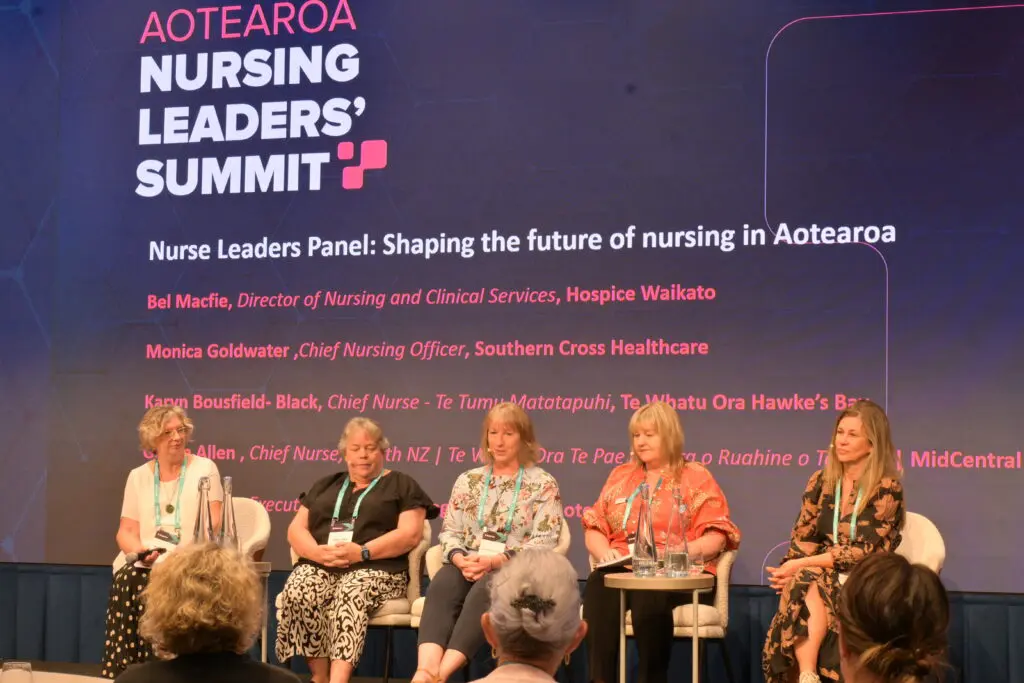
At Brightstar’s Nursing Leaders’ Summit earlier this year, nurse leaders from across Aotearoa New Zealand came together to address the pressing issues facing healthcare today. Moderated by Kate Weston, Executive Director of the College of Nurses Aotearoa, the esteemed panel featured:
- Bel Macfie, Director of Nursing and Clinical Services at Hospice Waikato
- Monica Goldwater, Chief Nursing Officer at Southern Cross Healthcare
- Karyn Bousfield-Black, Chief Nurse – Te Tumu Matatapuhi at Te Whatu Ora Hawke’s Bay
- Gillian Allen, Chief Nurse at Health NZ | Te Whatu Ora Te Pae Hauora o Ruahine o Tararua | MidCentral
Together, they discussed celebrating workplace successes, overcoming recruitment and retention hurdles, embedding a positive culture, and preparing for an increasingly technology-driven future.
Celebrating Success and Driving Competence
A core theme of the discussion was the impact of recognising achievements within teams. Monica Goldwater shared how Southern Cross Healthcare transformed staff education and compliance across its 19 hospitals by introducing an engaging, transparent system.
By upgrading to a modern learning management system and making completion metrics visible across all sites, the organisation created healthy internal competition.
“We created an organisational leaderboard where everybody’s information was up… We created a rotating trophy for learning excellence, put teams in the newsletter, and bought morning teas. Competition and celebration work well.”
– Monica Goldwater
This shift in approach – treating learning as an ongoing journey rather than a one-off orientation – led to over 80% completion rates across most hospitals involved, with several reaching 100% within a single quarter.
Overcoming Workforce and Recruitment Challenges
Addressing workforce shortages remains a top priority across region-wide healthcare networks. Gillian Allen highlighted MidCentral’s deliberate shift toward prioritising and supporting new graduate nurses to fill critical vacancies.
By establishing structured mentoring programmes to balance skill mixes and support new entrants, MidCentral successfully brought on 70 graduates within a few months. Creating space to connect directly with graduates – such as hosting informal coffee sessions – proved vital in boosting morale and reinforcing their value within the system.
Karyn Bousfield-Black detailed Hawke’s Bay’s proactive, forward-mapping approach. By retaining vacancies specifically for graduate intakes and maintaining strong nursing leadership in planning, they have consistently hired all local graduate nurses.
Culture as a Magnet for Retention
Beyond recruitment, building an uplifting workplace culture is essential for retaining talent. Karyn described Hawke’s Bay’s peer-to-peer recognition programme, where staff members submit short appreciation notes to colleagues across all levels.
- Peer Appreciation: Simple, direct recognition of positive behaviour transformed the everyday work environment.
- Top-down & Bottom-up Impact: Receiving unexpected notes of thanks – even as a Chief Nurse – proved deeply meaningful.
- Patient Impact: A supportive internal culture directly translates to better, warmer patient care.
As Karyn noted, when graduates decide where to practice, they are drawn to organisations with a strong, positive “vibe” where care and mutual respect are genuinely practised.

Equity, Diversity, and Expanding Scope
The panel tackled audience questions regarding diversity in leadership and adapting to modern scopes of practice:
1. Deliberate Growth for Māori and Pacific Nurses
Karyn emphasised the absolute necessity of prioritising scholarships, entry-to-practice programmes, and leadership pathways for Māori and Pacific nurses. Growing a culturally diverse workforce is not just a strategy – it brings irreplaceable depth and perspective to patient care for all users across Aotearoa.
2. Amplifying the Nursing Voice Through Storytelling
When communicating needs to executive or financial decision-makers, storytelling is essential. Monica highlighted that framing requests around tangible patient impact and risk – rather than simple resource requests – ensures nurse perspectives are heard clearly at every layer of management.
3. Maximising Scope Across Healthcare Teams
Rather than viewing expanding scopes (such as nurse prescribers, endoscopists, or health care assistants) as a challenge, the panellists agreed that enabling every team member to work at the top of their scope elevates the whole healthcare system. Upskilling support roles frees registered nurses to deliver higher-level care, improving overall patient contact and outcomes.
Looking to the Future: Tech, AI, and Keeping Humanity at the Core
Closing the session, Kate Weston noted the rise of non-traditional nursing paths, including telehealth and self-employed nurse consultants. Looking 10 to 15 years ahead, Bel Macfie pointed to digital literacy and AI as critical focus areas for the profession.
Bel emphasised that technological tools must be integrated into the culture rather than treated as external add-ons. Crucially, as the delivery of care evolves, nurses must actively articulate their unique value to ensure that human empathy remains at the centre of practice.
“How we retain the humanity and the uniquely nursing aspect inside of nursing will be our main challenge as technology advances – and we won’t do that unless we can clearly articulate what it is that we do.”
– Bel Macfie
Key Takeaways for Healthcare Leaders
- Visibility breeds engagement: Sharing performance data openly and celebrating milestones builds momentum and healthy accountability.
- Invest early in graduates: Clear onboarding, forward planning, and mentorship programmes secure the future workforce.
- Small gestures shift culture: Embedded peer-recognition programmes foster warmth, retention, and better patient outcomes.
- Embrace new scopes and tech: Adopting AI, digital tools, and extended nursing roles keeps the profession adaptable while preserving human-centred care.
📌 Be part of the conversation:
Join our upcoming healthcare leadership events, where top clinical and executive minds come together to share insights, tackle workforce challenges, and drive better outcomes for the country.
Explore our upcoming conference schedule today ▼